Miyoko Schinner vs. Satish Karandikar in battle of vegan heavyweights
[ad_1]


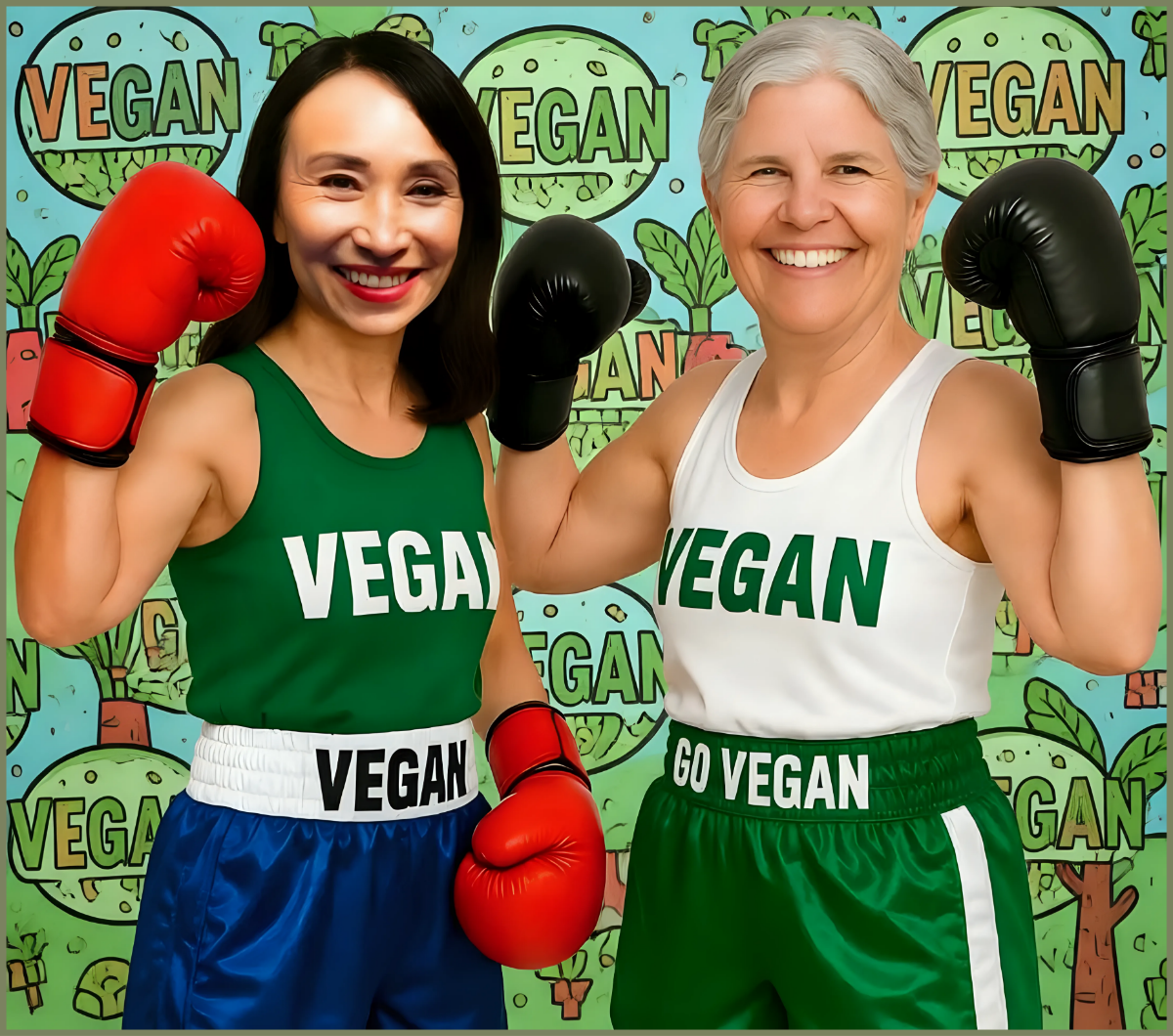
Miyoko Schinner & tag team partner Michele Simon. (Beth Clifton collage)
Miyoko tries to buy back Miyoko’s, after company that ousted her went bust, but Karandikar could be a contender
SONOMA, California––Contending for the vacated title of boss of the vegan cheesemaking firm Miyoko’s, in this corner of a Resolution Financial Advisors desktop in Los Angeles, longtime animal welfare donor and investor Satish Karandikar, 62, weighing in at $938 million in assets via the Ahimsa Foundation of Nimot, Colorado, plus the unknown credit value of Ahimsa Companies, of New York City.
In the opposite corner, Miyoko’s Creamery founder Miyoko Schinner, 68, knocked out of her own company in a 2022-2023 corporate coup-d’etat, weighing in with $102,343, 74% of what she hoped to raise through crowd funding after the corporation recently known as Miyoko’s without Miyoko officially went bust and entered into an Assignment for the Benefit of Creditors on October 6, 2025.
How many rounds this battle of vegan heavyweights may go is anyone’s guess.

 Bids were due on November 7, 2025
Ousting Miyoko from Miyoko’s took most of a year before she was counted out on May 18, 2023, with a cheesy jointly distributed media release in which the parties buttered each other up before separating like oil from water..
(See Cheese & crackers: Miyoko Schinner & Miyoko’s Creamery settle lawsuits.)
Bids to buy up whatever remains of Miyoko’s after three years without Miyoko in the vegan cheese boardroom were reportedly due on November 7, 2025, only two days after Elaine Watson of AgFunderNews on November 5, 2025 revealed that, “Miyoko Schinner is aiming to put together a bid to buy back the plant-based dairy brand she created.
“Other interested parties including Satish Karandikar are also understood to be putting together bids,” Watson added, noting that “Karandikar has not responded to a request for comment.”


Satish Karandikar. (Beth Clifton collage)
What’s an “Assignment for the Benefit of Creditors”?
Affirmed Miyoko Schinner herself via Facebook, “I am hoping to buy back Miyoko’s Creamery. I learned recently that it is up for sale, and I am putting together a team very quickly to make a bid for it. I believe I am the best chance for reviving the brand.”
Continued Watson, “According to documents seen by AgFunderNews, California-based Miyoko’s determined that it was “unable to pay its debts in full.”
The Assignment for the Benefit of Creditors process, handled for Miyoko’s without Miyoko by Resolution Financial Advisors, “is a means of concluding the affairs of an insolvent company as an alternative to the Chapter 7 bankruptcy procedure,” Watson explained.
“In an Assignment for the Benefit of Creditors,” Watson summarized, “the insolvent company transfers its assets, in this case, the brand, trademarks, formulas, etcetera, to an assignee in trust, who handles their sale” to pay creditors as much as the sale can raise.


Miyoko Schinner. (Facebook photo)
Started as Miyoko’s Kitchen
“Chef, author, and animal rights activist Miyoko Schinner” founded Miyoko’s as Miyoko’s Kitchen in 2014, Watson recalled, producing “artisanal cheese wheels made from cultured cashews “
Miyoko Schinner “later expanded into plant-based butter, mozzarella, cream cheese, spreads, shreds and slices,” and finally vegan butter, among the few products still on supermarket shelves under the Miyoko’s logo.
Post-Miyoko, Watson recounted, “In August 2023, ex-Coca-Cola exec Stuart Kronauge was brought in as chief executive officer. As part of a plan to drive efficiency, the firm later announced plans to close its production facility in Petaluma, California, and work exclusively with co-manufacturers,” meaning that manufacturing Miyoko’s products, which Miyoko Schinner had always personally supervised, was jobbed out.


(Beth Clifton collage)
“Values-aligned people”
“I’m putting together a team of people to make a bid,” Schinner told Watson. “I’ve got some values-aligned people with whom I am talking right now, and we’re hoping to put something together very, very quickly.
“I’m talking to some manufacturing partners,” Schinner continued to Watson, “but I don’t want to be chief executive or run operations any more.
“I have somebody in mind who is very values-aligned. I do want to be impactful in terms of product development, adhering to core principles in terms of quality and nutrition.
“We’re also talking about a structure for a company that is not reliant on what investors say,” Schinner said, “that is not top down, but more lateral, with mutual support. I want to do things differently.”
Although the Miyoko’s company has been making plant-based cheese and butter for eleven years now, Schinner acknowledged to Watson that “This is [still] a new category and it’s a case of how do you capture the right audience? I’ve been thinking about this very deeply for the last three years,” Schinner said, “as there’s less than 1% market penetration right now and low repeat purchase rates.”


Investor bailing out.
(Beth Clifton collage)
“Sales going backward”
Watson shared several grim statistics for anyone hoping that plant-based dairy products might soon be taking market share from producers of dairy cattle, buffalo, sheep, and goats.
“U.S. retail sales of refrigerated plant-based cheese are going backward,” Watson wrote, including an 8.5% decline so far in 2025 in total sales of refrigerated plant-based cheese.
On the other hand, plant-based cheese has attracted $220.3 million through October 2025 in cumulative sales, which circa 2000 might have been the total worth of the entire vegan food sector.
“The entire category is slipping,” Schinner acknowledged to Watson, “so we have to speak to the early adopters. The mass consumer is not interested. You’ve got to target the people who are.
“I would try to get cottage cheese out there that is equivalent to dairy in terms of nutrition,” Schinner suggested. “I don’t believe in adding isolated protein. I want to see, how do you concentrate those plant proteins in a natural state?


(Beth Clifton collage)
“People want brands that have an opinion”
“People are not interested in whitewashed, middle-of-the road, me-too brands. People want brands that have an opinion, a point of view,” Schinner concluded, “that stand for something, and that is what I would try to revive: a brand that stands for truth, equity, and sustainability.”
Float like cream, sting like sharp cheddar.
Added Schinner in a GoFundMe posting, VegEconomist reported on November 7, 2025, “I have quickly formed a small group of passionate, authentic people to run the company and produce the goods. My hope is to make an impact not just for animals but the food system, to take it back from the venture capitalists, private equity, and the multi-national corporations that are now running the food system and determining what we eat.”


(Beth Clifton collage)
Formidable competition
But Satish Karandikar is formidable competition, not only because he is a big cheese financially, but also because he has established his reputation as a vegan animal advocate through personally addressing animal issues of the day, often through social media, with a Who’s Who of prominent longtime fellow vegan animal advocates on his Facebook “friends” list.
As recently as September 29, 2025, for instance, Satish Karandikar wrote to local officials in opposition to the application of Trafalgar Fisheries to convert a former trout farm into a salmon farm at Downton, Wiltshire, United Kingdom, an issue few other billionaires would deign to notice.
“Ahimsa Companies,” according to Google AI, “is a private equity firm focused on acquiring and consolidating plant-based food companies, such as Wicked Kitchen, Simulate (Nuggs), and Blackbird Foods. It operates by consolidating brands to leverage shared resources like manufacturing and logistics to help them grow. The company’s strategy is driven by the goal of accelerating the transition to a more sustainable and ethical plant-based food system.”


Ethel Harper portraying Aunt Jemima in the 1950s. Image from the Ethel Earnestine Harper Papers, 1905-1981, courtesy of the North Jersey History & Genealogy Center of the Morristown & Morris Township Library
(Beth Clifton collage)
No interest in becoming a vegan “Aunt Jemima”
Conventional vegan business wisdom says this may be exactly what Mikoko’s without Miyoko needs to revive itself and grow––although conventional business wisdom, vegan or otherwise, also suggests that having Miyoko herself heading the company would be great public relations.
Schinner, however, long since made clear that she has no interest in becoming a vegan “Aunt Jemima,” a highly influential salesperson with her picture on the products but no actual clout within the company.
Though it must be noted that Nancy Green, the “real” Aunt Jemima from 1893 to 1900, and several of her successors, were role models with enduring positive cultural effect––and without them, there might never have been the wholly fictional Betty Crocker, invented to counter Aunt Jemima’s influence.
(See Veguary re-introduces Afro-Americans to plant-based eating.)


Miyoko Schinner kisses a goat.
(Beth Clifton collage)
“Let Miyoko buy back her own company”
“Let Miyoko buy back her own company. Stop the men trying to take it,” blogged attorney, vegan feminist, and Plant-Based Food Association founder Michele Simon.
“As many of my long-time followers know,” Simon began, “I built a 25-plus year career in food policy and advocacy. Along the way I became an ardent supporter of my friend and colleague Miyoko Schinner, the visionary founder of the vegan brand Miyoko’s.
“According to Agfunder News, another potential bidder is the animal rights philanthropist turned venture capitalist Satish Karandikar.


Eat Just founder Josh Tetrick & friends.
(Beth Clifton collage)
Just WTF?
“I wrote about him,” Simon reminded, “two years ago when he gave a head-scratching $16 million to failed and disgraced EatJust, maker of vegan eggs, but nothing else in over 14 years,” actually a stretch, since EatJust has marketed other products in the U.S. and Singapore, including Just Mayo, off the market for several years but re-launched in 2024.
Just Eggs, however, remains the EatJust company’s top-selling product.
“Speaking of failing companies,” Simon continued, “Karandikar is also behind a more recent deal with Beyond Meat for an eye-popping $100 million.


(Beth Clifton collage)
“What a crime it would be”
“What a crime it would be,” Simon opined, “for rich men to once again seize control from the woman who created this company, nurtured it from her kitchen, and transformed the plant-based cheese industry.
“We’ve seen this story before: women founders pushed aside so men can claim “leadership” and run the mission into the ground,” Simon fumed. “Miyoko didn’t just start a brand; she built a movement rooted in integrity, compassion, and culinary brilliance. Denying her the chance to bring her creation home would insult not only her but every fan who believed in her vision from the beginning.


Beth & Merritt Clifton.
(Daniel Leventhal photo)
“And beyond being wrong, it’s bad business,” Simon asserted, predicting “backlash and boycotts” if Schinner’s bid for Miyoko’s fails.
Satish Karandikar and Ahimsa Companies, however, having significant vegan bona fides and history of putting their money where their mouths are, make much less vulnerable targets than the relatively faceless and anonymous corporate cadres who forced Miyoko out of Miyoko’s.
Please donate to support our work:
More related posts:
Discover more from Animals 24-7
Subscribe to get the latest posts sent to your email.
[ad_2]
Miyoko Schinner vs. Satish Karandikar in battle of vegan heavyweights
Leave a Reply